


Federal Drug Conspiracy vs Possession in Indiana: How Prosecutors Build a Case
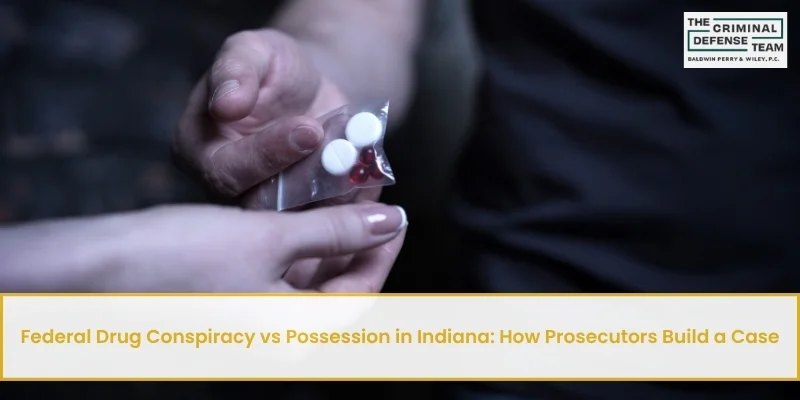
One important distinction in understanding federal drug conspiracy vs possession in Indiana is that prosecutors must prove different conduct. Possession centers on whether a defendant knowingly possessed drugs. The scope of conspiracy can encompass those who didn’t personally handle the drugs, provided there was some sort of agreement made between two or more individuals.
Federal Drug Defense From an Experienced Team
The Criminal Defense Team of Baldwin Perry & Wiley P.C. defends clients accused of serious state and federal crimes across Indiana. Our lawyers combine more than 100 years of experience and follow a team-based approach. We have at least two attorneys and a paralegal assigned to each case and participating in strategy sessions.
Indiana has only six Board- Certified* Criminal Trial Specialists, and five are a part of The Criminal Defense Team of lawyers. When choosing legal representation for a high-stakes criminal case, defendants can take specific credentials into consideration, much like when hiring a medical professional for a critical condition.
Possession and Conspiracy Require Different Evidence
Indiana sees its fair share of federal drug crimes. As reported by the United States Sentencing Commission, 35.7% of federal arrests in Indiana were for drug-related crimes. This equaled 227 sentences out of the 635 recorded by the Commission.
Federal law forbids simple possession under 21 U. S. C. § 844. Prosecutors usually must prove that a defendant knowingly or intentionally had illegal possession of drugs. Evidence could include the drugs themselves (as established by a search and forensic testing), any incriminating statements, or other evidence allegedly showing actual or constructive possession.
Federal drug conspiracy laws are different. Under 21 U.S.C. § 846, prosecutors can charge a person who conspired to commit another federal drug offense. The government does not need to prove that the substance offense occurred or was completed. Rather, prosecutors typically must show that two or more people made an agreement to commit a drug offense, and that the defendant knew and voluntarily became part of the conspiracy.
How Co-Defendant Statements Can Affect the Case
Conspiracy cases frequently involve more than one defendant. Multiple defendants can mean significantly more evidence for prosecutors to gather and present. Depending on the circumstances, prosecutors may seek to use testimony from co-defendants who cooperate with the government. They may use evidence such as recorded phone conversations or text messages to help build their case.
Why Conspiracy Charges Can Create Greater Exposure?
Drug possession penalties vary by offense and facts. A first offense for simple possession typically carries up to one year imprisonment. Penalties for conspiracy mirror the penalties for the drug offense that was the goal of the conspiracy. So, when the government charges conspiracy to distribute drugs, especially large amounts, defendants could face longer prison sentences. Conspiracy charges can also bring mandatory minimum sentences where applicable.
Hire a Federal Drug Crime Lawyer
If you are looking to hire a federal drug crime lawyer, an attorney can review whether the evidence proves knowing involvement versus association. An Indiana drug crime attorney can evaluate electronic evidence and the overall conspiracy allegations against you. Federal drug crimes charged in Hamilton County could be prosecuted in the Birch Bayh Federal Building & U.S. Courthouse located at 46 East Ohio Street, Indianapolis, IN 46204.
Five of Indiana’s six Board- Certified* Criminal Trial Specialists are attorneys who work at our law firm, and we can help you with your case. Contact The Criminal Defense Team today.
*Andrew Baldwin, Kathie Perry, Maxwell Wiley, Kelly Pyle, and Michael C. Cunningham are Board-Certified* Criminal Trial Specialists, as certified by the National Board of Trial Advocacy. Find out why having a Board-Certified* Criminal Trial Specialist as your defense lawyer is important here.