
Knowledgeable Wire Fraud Attorney in Indiana
Wire fraud accusations occur when it is believed that a defendant schemed to defraud others using wire communications. Your emails, texts, and online transactions can all be used in a case against you if you are accused. An Indiana wire fraud lawyer can discuss whether the evidence presented by the government actually proves all elements of the offense. The Criminal Defense Team can help.
The Criminal Defense Team for Your Complex Case
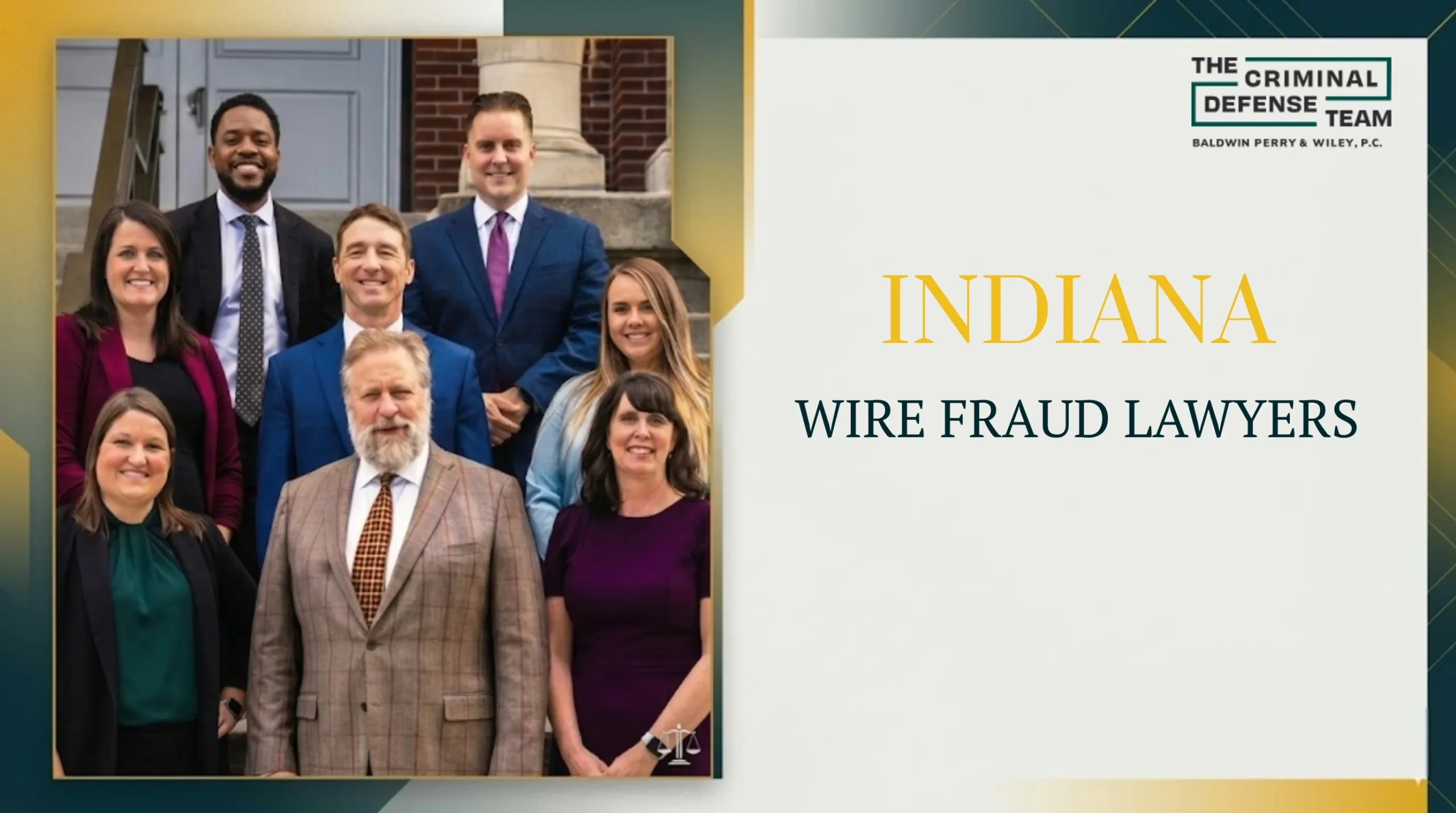
The Criminal Defense Team of Baldwin Perry & Wiley P.C. is an Indiana criminal defense law firm with over 100 years of combined legal experience. Every case we take is assigned to at least two attorneys and a paralegal.
This setup enables our attorneys to collaboratively devise defense strategies and distribute the tasks involved in sifting through extensive evidence. Our attorneys have prosecuted felonies and homicide cases at the state and federal level. Our prosecution experience provides unique insights into how the government may seek to organize its evidence and develop its theory of the criminal case.
Our Team
There are currently six Board-Certified* Criminal Trial Specialists practicing law in the State of Indiana. While not all of our attorneys are board-certified, five of the six board-certified attorneys in the state practice at The Criminal Defense Team. You won’t find another law firm in Indiana with five Board-Certified Criminal Trial Specialists.
When facing a serious health condition, you wouldn’t simply choose any doctor. Instead, you may seek a doctor who specializes in treating your condition. The same logic applies when you are facing a serious federal criminal charge.
Understanding Wire Fraud
Wire fraud is illegal under 18 U. S.C § 1343. In general, wire fraud requires a scheme to defraud or the intent to defraud along with the use of wire communications in furtherance of that scheme. Wire communication is a broad term that encompasses a wide range of communications. Examples of communications that could potentially be used in a wire fraud prosecution include:
- Emails
- Text messages
- Phone calls
- Online transactions
- Websites
- Online bank transfers
- Money wiring
- Other electronic communications that cross state lines
The government isn’t always required to prove that the defendant personally sent every communication. Even if not directly involved in the communication, the defendant can still be found in violation of the statute if the use of interstate wires to further the scheme was foreseeable and the wires were in fact used.
According to the United States Sentencing Commission, 4,804 federal convictions were for theft, property destruction, and fraud offenses. Crimes in this category include offenses that involve fraud and deceit. A significant majority, 75%, of defendants convicted of theft, property destruction, or fraud received prison time. The average sentence for offenders was 23 months.
What Must Be Proven?
Proving intent is often a key issue in wire fraud cases. To secure a conviction, the government must prove that a defendant intended to defraud another individual or entity. Showing that a business transaction resulted in a financial loss or that someone made an untrue statement may not be enough. Business and contractual disputes can sometimes lead to wire fraud charges. However, the following do not constitute wire fraud in and of themselves:
- Poor investments
- Breaches of contract
- Accounting mistakes
- Incorrect financial predictions
- Broken promises
Intent can often be proven through indirect evidence. The government may use emails, bank records, internal company emails, text messages, and statements made to the public, customers, or investors to try to establish what the defendant knew at the time certain representations were made. Defense strategies may attempt to cast doubt on whether the defendant’s statements show an intent to defraud when viewed in context.
Penalties for a Wire Fraud Conviction
Wire fraud is punishable by up to 20 years in federal prison. When financial institutions are affected, or the offense involves certain federally declared disasters or emergencies, penalties may be increased. Penalties can also include substantial fines. Wire fraud charges are unique in that separate wire transmissions may trigger separate offenses. This means that a discovery of numerous alleged fraudulent wire communications may result in multiple wire fraud counts.
A conviction is likely to result in serious financial penalties as well. This financial punishment could include fines, restitution, and forfeiture on top of imprisonment.
Evidence in a Wire Fraud Case
Wire fraud investigations typically result in a large amount of electronic evidence. When examining large amounts of evidence, it’s important to seek contextual evidence of all communications. A prosecutor’s case might hinge on a particular message they consider undeniable proof of a fraud. However, other emails sent immediately before or after that message may help clarify what the defendant understood or intended at the time.
Wire fraud charges brought in most of Central Indiana are prosecuted in the U.S. District Court for the Southern District of Indiana, located at the Birch Bayh Federal Building & U.S. Courthouse, 46 East Ohio Street, Indianapolis, IN 46204.
What to Do if You’re Charged With Wire Fraud?
You don’t have to be formally charged with a crime to know about a federal investigation. Federal agents can interview witnesses, serve search warrants, subpoena records, and contact relatives, friends, and business associates during an investigation.
Should you find yourself under investigation or facing federal charges, take steps to preserve evidence that may be requested during the investigation. Do not delete emails or alter records.
Additionally, try not to interview witnesses or explain your side of the story directly to federal agents. Anything you say to the government can be used against you in court. Also, if you try to interview witnesses yourself, this can open the door for additional charges, such as witness tampering. Instead of talking to investigators, begin compiling evidence that may help explain your side of the story. Share these with your Indiana wire fraud attorney.
Why Hire a Wire Fraud Lawyer?
When you hire a wire fraud lawyer, you should seek out an attorney who can analyze both the substance of the alleged scheme as well as the electronic evidence the government plans to use. An experienced defense attorney can help by examining whether the government can prove fraudulent intent by reviewing the evidence against you and preparing for trial.
At The Criminal Defense Team of Baldwin Perry & Wiley P.C., we partner together to provide more than 100 years of collective experience to clients facing criminal charges. While not all of our attorneys are board-certified, five attorneys who comprise Indiana’s six total Board- Certified* Criminal Trial Specialists are members of The Criminal Defense Team. Contact us today to learn about wire fraud laws and your legal options.
*Andrew Baldwin, Kathie Perry, Maxwell Wiley, Kelly Pyle, and Michael C. Cunningham are Board-Certified* Criminal Trial Specialists, as certified by the National Board of Trial Advocacy. Find out why having a Board-Certified* Criminal Trial Specialist as your defense lawyer is important here.