
Experienced White-Collar Crime Attorney in Indiana
White-collar criminal investigations can threaten careers, professional licenses, businesses, financial resources, and reputations long before trial. An Indiana white collar crime lawyer can review complex financial accusations. White-collar investigations often involve years of transactions across thousands of documents. Getting ahead of these accusations early can be crucial.
White collar investigations impact professionals and businesses across Indiana, including business owners and individuals who work along commercial corridors like downtown Indianapolis and the North Meridian Street corridor. Federal white-collar cases from central Indiana are often heard at the Birch Bayh Federal Building and U. S. Courthouse in downtown Indianapolis near Monument Circle and the Indiana Statehouse.
Defense Structure Designed for Complex Cases
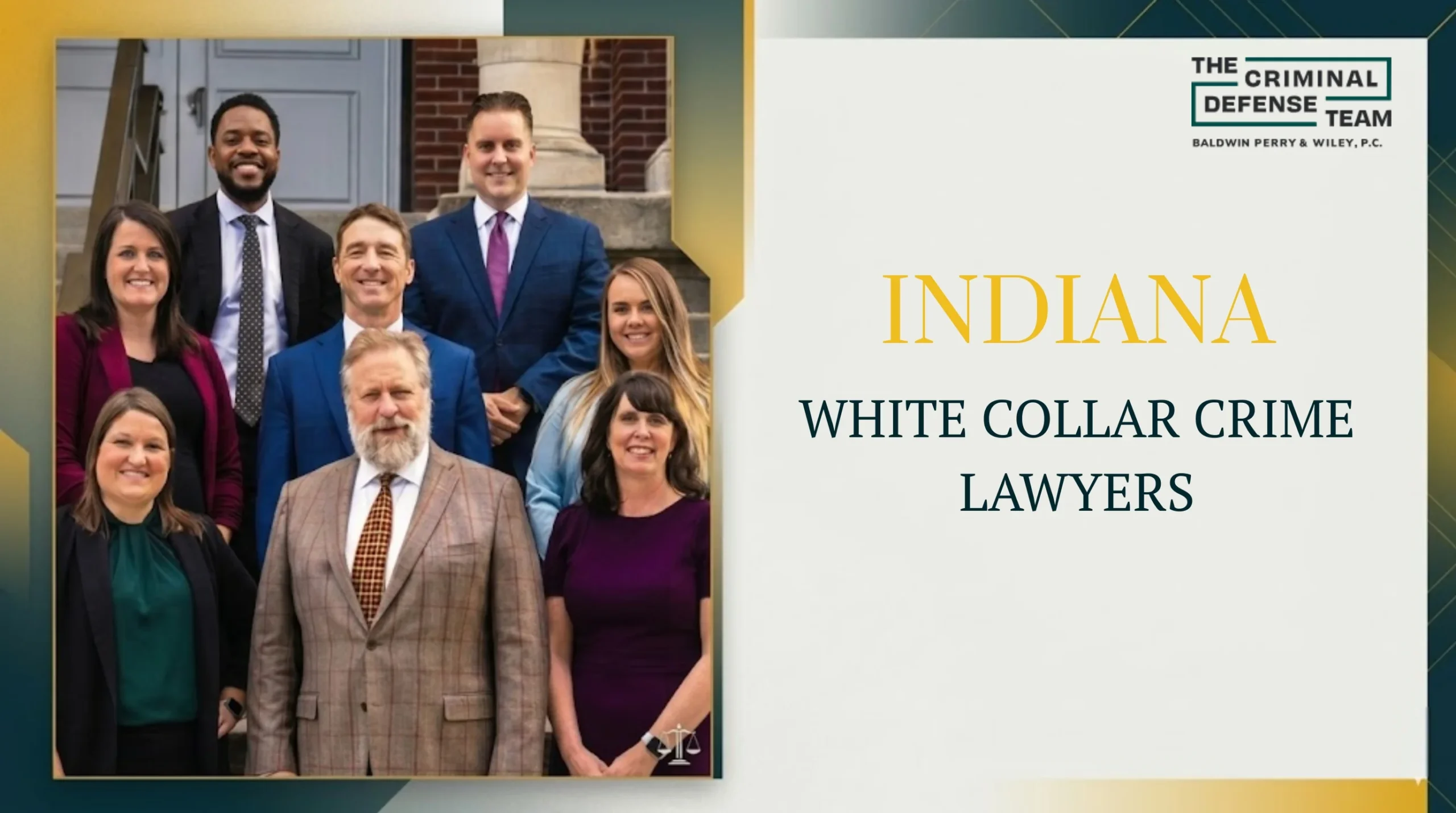
At The Criminal Defense Team, serious cases receive attention from at least two of our attorneys and a paralegal. Having more than one lawyer review large volumes of evidence allows our lawyers to split up the task of reviewing evidence. Our attorneys also brainstorm together to develop defense strategies.
As a team, we also have more than 100 years of experience handling Indiana criminal cases. Our former prosecutor knows what triggers offenses at the prosecutor’s office and how prosecutors build felony and homicide cases. Only six criminal trial lawyers in the entire state of Indiana are Board-Certified* Criminal Trial Specialists. Five practice at The Criminal Defense Team.
You would not visit just any doctor if you had a serious medical condition. You would seek out a specialist. When your freedom is on the line in a serious criminal case, you should consider hiring a specialist too.
What Is Considered a White-Collar Crime?
The term white-collar crime is a broad term that describes many kinds of deceptive or financially motivated crimes. White-collar crimes may involve accusations of deception or using a position of:
- Trust
- Business relationship
- Electronic communications
- Financial transactions
The purpose of these is to acquire money or property or hide other illegal activity. What white-collar crime laws apply to the situation varies based on the conduct, alleged victim, method used, how much money was involved, and whether activity crossed state lines or involved a federally created program.
The Financial Impact
Federal agencies have significant resources that allow them to investigate financial crimes. For fiscal year 2025, IRS Criminal Investigation played a role in uncovering more than $10.59 billion in financial crimes. Tax fraud alone accounted for close to $4.5 billion of the total.
The reasons why federal agencies devote resources to enforcing financial crimes show just how complex federal investigations can become when large volumes of banking records, tax returns, and electronic information are involved.
Securities and Investment Fraud
Indiana regulates securities through the Indiana Uniform Securities Act. Indiana law against securities fraud can be found at Indiana Code § 23-19-5-1. Indiana’s securities fraud statute makes it a crime to commit fraud in connection with the sale or purchase of securities. This includes using a scheme to defraud and knowingly making or omitting material information. Securities law violations may include accusations of:
- Making false statements to investors
- Omitting material facts
- Engaging in unauthorized trades
- Diverting investment funds
- Insider trading
- Scheming to defraud in connection with stocks or other securities
Securities fraud matters can also invoke the attention of federal regulators. The federal Securities and Exchange Commission may investigate activity that could lead to federal criminal charges.
Embezzlement and Employee Theft
While Indiana law may not have a crime specifically titled embezzlement, prosecutors can still charge someone who illegally takes control of another individual’s property. Embezzlement is often charged under Indiana’s theft statute, Indiana Code § 35-43-4-2. Employee theft or embezzlement cases can arise out of accusations that a business owner, employee, accountant, fiduciary, or other person took or diverted money without permission.
The key in many of these cases is often the difference between having access to company assets and being authorized to use those assets. An individual may have been authorized to schedule payments, use a company credit card, transfer funds, or access an account. However, the questions are whether the defendant had permission to complete the transactions they are accused of and whether there was criminal intent.
Various Types of Fraud
Fraud can take many forms. Bank fraud or loan fraud charges may be based on accusations that false information was used to secure financing. Mortgage fraud may include crimes related to property values, income, occupancy, actual ownership, or other documents submitted during the transaction.
Healthcare fraud can encompass allegations of billing for services never rendered, using improper coding, engaging in kickbacks, providing services not medically required, or submitting false or unlawful claims to government health programs. Insurance fraud involves allegedly false information regarding losses. Business fraud can involve false invoices, contracts, journal entries, vendors, or related party transactions.
Just because an inaccurate document exists does not mean someone committed fraud. Prosecutors must prove the defendant had the mental state required by the criminal statute.
State vs. Federal White-Collar Crime Charges
Indiana prosecutors generally handle violations of Indiana criminal law such as theft, fraud, and forgery, as well as other offenses prosecuted by Indiana’s state statute. Federal prosecutors may become involved when someone’s conduct violates federal law, impacts federally insured institutions or programs, or crosses state lines.
Federal white collar crime investigations can involve federal agencies such as the FBI, IRS Criminal Investigation, or the U.S. Postal Inspection Service. Additionally, some of these investigations can go on for months or years before an indictment is even returned.
Federal white collar crime charges filed in central and southern Indiana are typically heard in the Birch Bayh Federal Building & U.S. Courthouse located at 46 East Ohio Street, Indianapolis, IN 46204. The courthouse is conveniently located in downtown Indianapolis near Monument Circle and the Indiana Statehouse.
Penalties for White Collar Crimes
White collar crime penalties vary depending on the statute under which someone is prosecuted and whether the charges are brought in state or federal court. In Indiana, offenses can range from misdemeanors to serious felonies. The amount of financial loss, number of victims, defendant’s role in the offense, criminal history, and existence of aggravating circumstances can have an effect on the severity of penalties.
Federal sentencing has its own set of statutory penalties and sentencing guidelines. Just like in Indiana, the sheer financial damage, along with other elements of the offense, can play a huge role in federal fraud cases.
Convictions can lead to court-ordered restitution and forfeiture if authorized by statute. Other employment-related consequences of a conviction can include loss of professional licenses and other positions and privileges. Immigration status and the ability to work in certain industries can also be affected.
The Investigation Process
Police don’t always show up at the scene of a crime ready to make an arrest in a case. An individual may first hear about an investigation when served with a subpoena, search warrant, or request for records. They may also receive a call from federal agents. Sometimes an employer or business realizes there is a discrepancy in the accounting records and launches an internal investigation. Law enforcement may become involved. Investigators use evidence such as:
- Bank statements
- Emails
- Accounting documents
- Phone records
- Corporate records
- Testimonies and statements from employees or other witnesses
Forensic accountants and other professionals can also become part of the equation if transactions or financial records require interpretation.
This vast amount of evidence holds the potential to be both beneficial and damaging. One transaction may look questionable alone, but can be explained when compared to the contract, email correspondence, authorization, and regular business practices. Essentially, evidence needs to be looked at both individually and in the context of the whole situation.
Defense Issues
No single white collar defense is going to apply to every situation. These cases are very fact-dependent. However, a significant number of these cases revolve around the defendant’s knowledge and intent. For example, just because an investment fails, that does not mean securities fraud occurred. Defense counsel should investigate:
- Whether prosecutors can establish intent
- Whether the defendant was the one who actually made an alleged representation
- Whether transactions were really authorized
- Whether financial computations are correct
- Whether prosecutors have taken statements and communications out of context
Lawyers should analyze the evidence to also make sure none of it was obtained illegally. If evidence was obtained illegally, there may be various pretrial motions to address that issue. If the evidence is thrown out, it can weaken the case against you.
Hire a White Collar Crime Lawyer
If you need an Indiana white collar crime attorney, you want to hire a white collar crime lawyer who has the resources to review the financial and electronic record of the incident in question.
At The Criminal Defense Team of Baldwin Perry & Wiley P.C., our lawyers defend clients against serious Indiana state and federal criminal charges. We handle each case with a team- based structure and have substantial resources dedicated to reviewing discovery. We also operate a 24/7 lawyer on-call system to make sure we are highly accessible to our clients.
When facing a white collar crime charge or investigation, you need a lawyer who can dive into the financial analysis of your case. Your freedom and career may depend on it. Five of Indiana’s six Board Certified* Criminal Trial Specialists are criminal defense attorneys at The Criminal Defense Team. Our lawyers can help give your case the attention it needs. Contact us to discuss your Indiana white collar crime investigation.
*Andrew Baldwin, Kathie Perry, Maxwell Wiley, Kelly Pyle, and Michael C. Cunningham are Board-Certified* Criminal Trial Specialists, as certified by the National Board of Trial Advocacy. Find out why having a Board-Certified* Criminal Trial Specialist as your defense lawyer is important here.