


Stopped at a Hamilton County Sobriety Checkpoint?
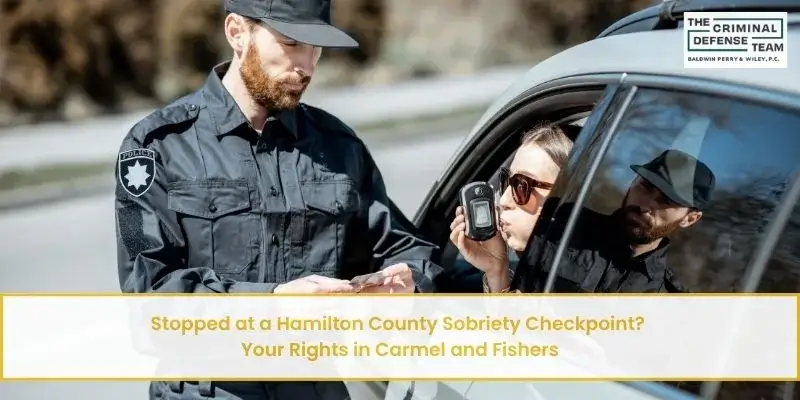
Driving through Hamilton County, Indiana, and stopping at a Hamilton County sobriety checkpoint can be unnerving. Whether during holiday weekends, community events, or times of increased traffic enforcement efforts in Carmel and Fishers, Indianapolis drivers can quickly find themselves stopped at a Hamilton County sobriety checkpoint.
About The Criminal Defense Team of Baldwin Perry & Wiley, P.C.
Founded by Indiana criminal defense lawyers, The Criminal Defense Team of Baldwin Perry & Wiley, P.C., represents clients in criminal cases throughout the state. Our attorneys are dedicated to the criminal defense client, offering a level of personal service you will not find at larger firms.
Attorneys at The Criminal Defense Team of Baldwin Perry & Wiley, P.C., have five of Indiana’s six Board-Certified Criminal Trial Specialist certifications. The firm also contains over 100 years of criminal defense experience combined and takes all serious cases.
One of our attorneys previously worked as a prosecutor, focusing on serious felony cases and homicides. This experience allows him to know how to poke holes in the state’s narrative and evidence, which sets us apart from other local competition. By having multiple attorneys and a paralegal working on most cases, we are able to prepare thoroughly on your case and respond promptly to your needs.
What Happens at a Sobriety Checkpoint
Every day, about 28 Americans lose their lives in drunk driving incidents. That is one person every 52 minutes, or 10,000 people a year.
At a checkpoint stop, law enforcement will generally stop vehicles based on a predetermined pattern rather than stopping individual drivers at random. Police may ask drivers a few questions, request to see a driver’s license and proof of registration, and look for obvious signs of intoxication. Slurred speech, bloodshot eyes, and the smell of alcohol can all factor into an officer’s decision to investigate further.
Officers may ask the driver to proceed to a secondary screening area for further investigation if they suspect impairment. That further investigation could include field sobriety exercises and/or a request to take certified chemical testing. While checkpoint encounters are supposed to be brief, the stop could take longer if an officer believes there is cause for further investigation.
Your Rights at a Sobriety Checkpoint
Drivers stopped at a sobriety checkpoint in Hamilton County still have constitutional rights under both Indiana law and the US Constitution. Police can ask you questions at the checkpoint and request identification, but you do not have to answer potentially incriminating questions about alcohol consumption or other details about your night.
Drivers should also remember that they have the right to remain calm and not consent to searches beyond what officers are allowed to conduct. In many cases, drivers later dispute an officer’s decision to prolong the traffic stop or conduct a more in-depth investigation.
The initial traffic stop itself may also become a point of contention. Courts will sometimes look at whether law enforcement established the checkpoint according to constitutional and statutory requirements.
Carmel Driving Under the Influence Laws
Indiana operates under Indiana Code § 9-30-5, which governs operating while intoxicated (OWI) offenses and penalties. Prosecutors can file allegations against a person who is impaired by alcohol, controlled substances, prescription medication, or some combination of the three.
Depending on the facts, allegations can range from misdemeanors to serious felony offenses. Felony DUI charges can arise from repeat alcohol or drug convictions or accidents causing injury to others.
Indiana also has an implied consent law. This means that all drivers inherently agree to chemical testing when driving. Refusal to submit to certified chemical testing will result in an automatic suspension of your driver’s license, even if criminal charges are never filed.
Digital and Video Evidence
Increasingly, DUI investigations in Fishers involve significant digital evidence. This can include body camera footage, dashboard camera video, dispatch records, and chemical testing records.
Video evidence may provide more information about the traffic stop itself, the roadside testing environment or conditions, or what the officer observed. You may also have questions about field sobriety testing or calibration of breath test machines. Additionally, certain medical conditions can impact a driver’s appearance or ability to perform roadside exercises.
For these reasons, it’s important to recognize that Fishers’ DUI cases have the potential to be more complex than many drivers realize due to the technical nature of the evidence.
FAQs
Are Sobriety Checkpoints Legal in Indiana?
Indiana does allow sobriety checkpoints and impaired driving enforcement programs under some circumstances. The Indiana state police are required to conform to constitutional rules as well as certain requirements when making DUI stops. Factors that can be considered by courts include adequate planning in advance of the stop, objective detention of motorists, and reasonableness of the overall stop.
Do Checkpoints Violate the 4th Amendment?
Sobriety checkpoints present Fourth Amendment concerns, since motorists are momentarily detained without individualized suspicion. The courts have, in fact, ruled that some checkpoint systems can be lawful as long as they are carried out under particular directives that limit arbitrary enforcement. Whether a checkpoint is deemed constitutional usually comes down to its initial design and how it’s implemented.
Is It Illegal to Turn Around at a Sobriety Checkpoint?
There is no Indiana statute that expressly prohibits motorists from turning around before reaching a sobriety checkpoint. That said, police will likely have watched you execute your turn and may pull you over anyway for an independent reason, such as committing a traffic violation or suspicious behavior while turning around. Any traffic/lane violations, erratic driving, or equipment violations you commit may give the officer an independent reason to pull you over.
Are Checkpoints Considered Entrapment?
Checkpoint stops are typically not entrapment since no officer is persuading someone to commit a crime. Sobriety checkpoints are an enforcement mechanism meant to catch already intoxicated drivers who are operating their vehicles on public roadways. Entrapment occurs when law enforcement causes someone to commit a crime. A checkpoint stop may still be found unconstitutional depending on how the checkpoint was administered.
Hire a DUI Lawyer to Understand Your Rights
Checkpoint investigations happen quickly, especially when officers suspect impairment. Many DUI attorneys’ clients have questions about the evidence against them, potential penalties, and what to expect next.
At The Criminal Defense Team of Baldwin Perry & Wiley, P.C., our attorneys focus exclusively on criminal defense throughout Indiana. Our attorneys include five of the state of Indiana’s six Board-Certified Criminal Trial Specialists and can help you in your case. Contact us today for more information and to hire a DUI lawyer.
*Andrew Baldwin, Kathy Perry, Kelly Pyle, Maxwell Wiley, and Michael C. Cunningham are Board-Certified* Criminal Trial Specialists, as certified by the National Board of Trial Advocacy. Find out why having a Board-Certified* Criminal Trial Specialist as your defense lawyer is important here.